Selection of potentially influential variables
A team of expert professionals was put together (four primary care midwives, four hospital midwives – all with more than 10 years’ experience – three pediatric nurses, a pediatrician, three psychologists, three health science researchers and two postpartum women). Based on literature and their own experience, they identified some physical, cognitive, emotional, cultural or social factors that could influence the experience of pregnancy, childbirth and postpartum and, presumably, in subsequent HRQoL9,18.
The selected variables were classified into (1) personal characteristics: (sociodemographic, medical or obstetric history, lifestyle, psychological state (emotional state, anxiety, depression); and (2) expectations or beliefs regarding childbirth (previous experience (parity, fear of childbirth, coping strategies, or perception of self-efficacy regarding childbirth).
As a dependent variable, quality of life in the postpartum period was considered2,3,4.
Instruments for measuring variables
The variables considered were age, parity (primiparous/multiparous), educational level (university /no university), employment status (paid work/housewife), and nationality (Spanish/immigrant). The “history” variable had two yes/no options, and grouped together previous medical pathologies (e.g. HTN, heart disease), pathologies of the current pregnancy (e.g. gestational diabetes, preeclampsia) and prematurity or previous perinatal death. The lifestyle variable, also with two options (yes/no), included the consumption of tobacco, alcohol or other drugs in this pregnancy.
Anxiety during pregnancy was measured using the STAI-S questionnaire. This is a self-report made up of 20 items with a 4-point Likert answer system depending on intensity. The total score ranges between 0 and 60 points, and a higher score corresponds to a higher degree of anxiety19.
Depression during pregnancy was measured with the self-administered Edinburgh Postnatal Depression Scale (EPDS). This consists of 10 items about the presence of depressive symptoms in the last 7 days, with four response categories according to the increase in the severity of the symptoms described20.
The quality of the relationship with the partner was assessed using the PSEQ Partner Support scale, which includes 8 items rated from 0 to 3. These items measure the partner’s interest in the woman’s needs as an expectant mother, his adjustment to the new paternal role, empathy, understanding, support, cooperation, communication, and expressions of trust toward her. The total score ranges from 0 to 24 points21.
Fear of childbirth was measured with the Wijma-A questionnaire, a self-administered questionnaire made up of 33 items which are evaluated on a scale from 0 to 5, reflecting extreme feelings or thoughts. The highest score reflects more fear, ranging from 0 to 165. The questionnaire was validated for the Spanish population by Ortega-Cejas et al.22.
To analyze coping strategies, the self-administered questionnaire Revised Prenatal Coping Inventory (NuPCI) was used, which includes three scales with sufficient internal consistency: (a) preparation strategies (15 questions), (b) avoidance (11), and (c) spiritual (6). Answers are given on a scale from 0 (never) to 4 (very often) depending on how often they have used each strategy in the last month23.
The perception of self-efficacy regarding childbirth was assessed with The ChildBirth Self Efficacy Inventory (CBSEI), which has four subscales; two with 15 items for the dilation phase (outcome expectancy (OE) and Efficacy expectancy (EE)), and another two for the expulsion phase with the same 15 items and the additional item of “‘Focus on the person helping me in labor”. Each item is answered from 0 to 1024.
Finally, postpartum HRQoL was measured with the SF-12v2 questionnaire. This is a reduced version of the SF-36 consisting of 12 questions and requires an administration time of only 2–3 min. The main strategy for interpreting these questionnaires is the use of population norms. The questionnaire was validated for the Spanish population by Schmidt et al.25.
Participants
This study is part of a broader piece of research that has analyzed women’s perceptions and needs during pregnancy, childbirth and postpartum, and has involved the development and validation of two scales for these measurements in pregnancy and postpartum in the Basque Country18. It is a longitudinal study, carried out between January 2019 and June 2022, with a sub-sample of this group, who were women attended in the public health service (Osakidetza). Osakidetza is a universal, free health service, which serves an approximate population of 2,200,000 people between the 3 provinces of the Basque Country. Health care is provided through a structure of 13 Integrated Health Organizations (OSIs), made up of a hospital and a network of primary care centers with an average of one midwife each to care for low-risk pregnancies. Women at high risk are supervised by an obstetrician. The target population was all pregnant women over 18 with a good knowledge of Spanish language.
Before accessing the questionnaires, the women received the Patient Information Sheet and the consent form online, and only when the informed consent was given was access provided to the measurement instruments, sociodemographic forms, and questions about clinical history. At the end, the women were asked if they would be willing to participate in the study again once the birth had happened, and if so they were contacted again, following the same procedure, but with the postpartum HRQoL questionnaires and some questions about the birth and their state of health at that time.
The study was approved by the Basque Country Clinical Research Ethics Committee (PI20219110).
The midwives proposed 341 women to take part in the study, while another 80 were included by informal contact among the participants. Finally, 263 women answered the prenatal questionnaire and, of these, 92 also answered the postnatal questionnaire. Table 1 shows various parameters of the study population.
Statistical analysis
Descriptive statistics were calculated to characterize the sample. Categorical variables were summarized using absolute and relative frequencies, while continuous variables were described using means and standard deviations. The normality of continuous variables was assessed using the Shapiro–Wilk test, visual inspection of Q–Q plots, and evaluation of skewness and kurtosis. Spearman’s correlation coefficients were computed to examine associations among the main variables.
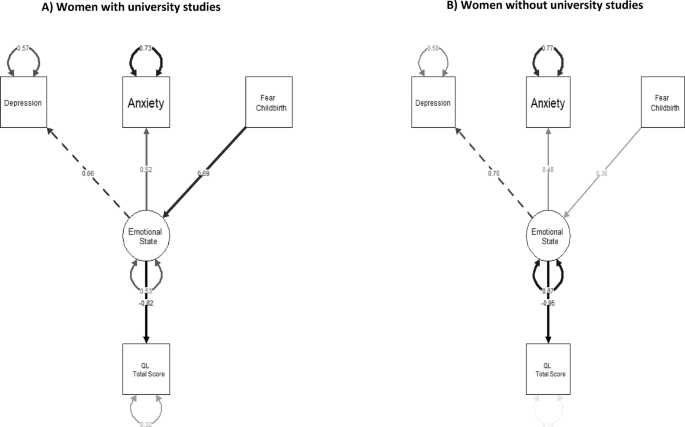
Next, multivariate analyses were conducted to explore the relationship between quality of life in its physical and mental dimensions and potential associated factors. Three structural equation models (SEMs) were specified, using the SF-12 total score (QL total score), the physical component summary (QL physical score), and the mental component summary (QL mental score) as outcome variables.
Model fit was evaluated using standard indices: the chi-square statistic (χ2) and its ratio to degrees of freedom (χ2/df), the Comparative Fit Index (CFI), the Root Mean Square Error of Approximation (RMSEA) including its 90% confidence interval, and the Standardized Root Mean Square Residual (SRMR). Accepted thresholds were: χ2/df < 3, CFI > 0.90, RMSEA < 0.08 with a 90% confidence interval lower bound close to 0 and upper bound below 0.10, and SRMR < 0.08. Backward elimination was applied to retain only statistically significant paths in the final models. Full versus reduced models were compared using likelihood ratio tests and partial F-tests.
Multi-group SEM analyses were performed to examine potential differences in path coefficients between women with and without university education, using educational status as the grouping variable. Given the simplicity of the final models, the sample size was considered acceptable based on recommendations for multi-group SEM with small models and limited parameters26,27. Nevertheless, results are interpreted with caution due to the limited statistical power to detect small between-group differences.
Statistical significance was set at p < .05. All analyses were conducted in R version 4.1.0 using the lavaan package for SEM.
link
About the Author